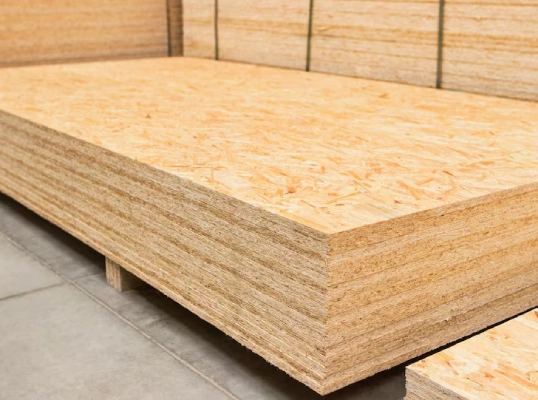
How is OSB made?
OSB is made from wood strands 8 to 15 centimetres long. It uses the whole tree and makes use of crooked, knotty and deformed trees that would otherwise go unused. It is a solid uniform panel, with enhanced features, and high strength and water resistance.
What is OSB used for?
OSB products are widely used for structure and non-structural uses. As a lightweight, strong and versatile wood product it can be used for roof, wall and floor sheathing. It is also sometimes used as the web material for prefabricated I-joists and a skin material for structural insulated panels. As a strong, stable panel it generally won’t warp and will resist wind and seismic loads. Other uses of BC-made OSB include RV fabrication and cargo-van panels, pallets, industrial containers, marine applications and furniture manufacturing.
How does OSB compare to other products?
Similar to plywood, OSB is often a go-to product and preferred for its many common uses. OSB can be fabricated into panel that are larger than plywood. Compared to plywood, OSB is heavier and swells more when wet, especially at panel edges, retaining water longer than plywood. Regardless of their differences, OSB and plywood are comparable products fabricated to meet the same standards of strength and structural performance. Nonetheless OSB provides exceptional light-weight strength and durability.